Welcome to our June issue of the GALILEO.
Our September issue has just been released and is available for our full members. In the meantime, for visitors, our last issue is now available for you to enjoy.
Welcome to our June issue of the GALILEO.
Our September issue has just been released and is available for our full members. In the meantime, for visitors, our last issue is now available for you to enjoy.
Andorian Bajoran Cardassian Denobulan El-Aurian Ferengi Gorn | Human Idanian Jem'Hadar Kazon Malon Nausicaan | Orion Pakled Quarren Rigelian Suliban Tellarite | Undine Vulcan Wadi Xindi Yridian Zalkonian |

Welcome to our March issue of the GALILEO.
Our June issue has just been released and is available for our full members. In the meantime, for visitors, our last issue is now available for you to enjoy.


The science fiction of yesterday can very fast become the science
fact of today. It's as if science fiction throws down a challenge to our
scientists: Hey, have you seen this? Bet you can't make this one! But before
we know it, it's been made. Here are just five such examples.

Remember
in The Original Series, the record tapes? Those coloured cubes or
rectangular pieces of plastic were data storage devices. Inserting them into a
desktop computer console or terminal, they were used to store all manner of information
on the Enterprise.


Of course, one can't mention any of these developments
without thinking of the iconic Star Trek communicator.
Surely this device inspired the flip-phone. I wonder how
many of us enjoyed opening our flip-phones Kirk-style?

* * * * *
Those are just three of the inventions we take for granted,
but what about more significant developments? Here are two.

In 1951, Carl Wiley (under the pseudonym Russell Saunders)
wrote an article called "Clipper Ships in Space" for Astounding
Science Fiction about how solar sails could be built in orbit and used for
space travel.
Cordwainer Smith also published a science fiction story "The
Lady Who Sailed the Soul" in Galaxy Magazine in 1960. Although
more of a romance, the story also describes a solar sail spaceship.
Then we have Pierre Boulle’s novel, "Planet of the
Apes" in 1963, in which he describes Jinn and Phyllis's sail craft as
"a kind of sphere with a shell—the sail—made of amazingly thin material,
and it would move through space, just pushed by the pressure of light
beams."
So, by the time Star Trek: Deep Space 9 utilised the theory
in Explorers, when Jake and Benjamin Sisko create such a craft in a
father/son bonding exercise, it was old hat in sci-fi terms.
Today, solar sails have been developed and used in a raft of
projects in varying guises, but on 21 May 2010, Japan Aerospace Exploration
Agency (JAXA) launched the world's first interplanetary solar sail
spacecraft "IKAROS" (Interplanetary Kite-craft Accelerated by
Radiation of the Sun) to Venus. Using a new solar-photon propulsion method, it
was the first true solar sail spacecraft fully propelled by sunlight, and was
the first spacecraft to succeed in solar sail flight.

In 1986, this sounded fanciful, but aluminium oxynitride,
aka ALON, is the real-world transparent aluminum.
It's a transparent ceramic composed of aluminium, oxygen and nitrogen. Four
times harder than glass it is optically transparent, and bulletproof to
anything up to and including a 50-caliber round.


Now becoming a regular feature on the second Thursday of each month, we had nother excellent Quiz Night in April.
Our winners were:
1st: Aaron with 14 points
2nd: Hightower with 13 points
3rd: Erika with 11 points
Well done, everyone!

For the next quiz night, I thought we'd follow a similar format BUT how about
... 2 points if you can get the answer without a hint
... 1 point if you ask for a hint and get the answer right. For the hint, I will give you a choice of three or four answers to choose from! 😃
Next Quiz Night will be 10th April 2025 at 8pm. 🖖😊

The USS STARGAZER held a quiz night last night and it was really good. With around forty questions, a large number of the crew took part and, ignoring the fact that we had to send three to the brig, fun was had by all. The Second Office, it turns out is a bit of an Oracle when it comes to Trek, but everyone had fun.


Yesterday evening was the first of our new Monthly Virtual Meetings for the crew. Designed along the same lines as a face-to-face meeting, we used Zoom. Members could arrive at any time they wished during the meeting, and leave at any time, too. Scheduled for the FOURTH THURSDAY of each month, it is a very relaxed way to get together and chat about, well, anything really.

I am so looking forward to next month's meeting!
 We are delighted to be able to offer USS STARGAZER comm badges for sale.Truly beautiful, they are £14.50 each with free UK postage. If you would like to add one of these beauties to your uniform or collection, please contact me to arrange payment and delivery details.
Thank you.
CAPT Anni Potts
potts-stargazer at abpotts.co.uk
We shall also be having a Trek themed quiz night for our members in the first week of February. If you would like to join us, please do contact us. Thank you.

The USS Stargazer is very proud to announce that it is reintroducing virtual meetings. Coming together once a month, full crew members of the Stargzer will be meeting and chating on line.
To join us, you will need to be a full member of Stargazer, so iI you would like know more, please message me for more details.


A very warm welcome to our new website. Here, everybody will be able to catch up on the latest news from the USS Stargazer. Be it the latest issue of our newsletter or news about our latest or forthcoming chapter meet, both virtual or face-to-face, you can find out about them here. To take full advantage of some of these things, you will need to be a full member of our chapter, but at about £8.00, hopefully, that means you won't have to dig too deep into your pockets. So, what are the benefits of full membership to our chapter?
So, why not join us, just click on the link to the right or below ...
https://sfi.org/membership-prices/
... and don't forget to add the USS Stargazer as your chosen chapter.
Greetings and Welcome from the USS Stargazer
Hello there and welcome to the USS Stargazer, a Star Trek fan group and chapter of STARFLEET International's 20th Fleet, (Region 20), which covers the UK (Wales, England, Scotland and Northern Ireland), Republic of Ireland, and surrounding islands.
In the Trek world, we are a Sagan class starship of which I am honoued to be the commanding officer. I n the ral world, I live in Milton Keynes but we have members from across the entire country and beyond, meeting on Facebook via our crew only group, and once a year in person with a face-to-face event. In between times, we have regular video chats as well as quizzes, a chapter newsletter, Star Trek episode discussions. Region and Chapter challenges and much more to boot. Our members enjoy watching all forms of Star Trek as well as a multitude of other sci-fi franchises, and we discuss them all, so don't be surprised to find a chat about Babylon 5, Star Wars or another sci-fi series popping up from time to time.
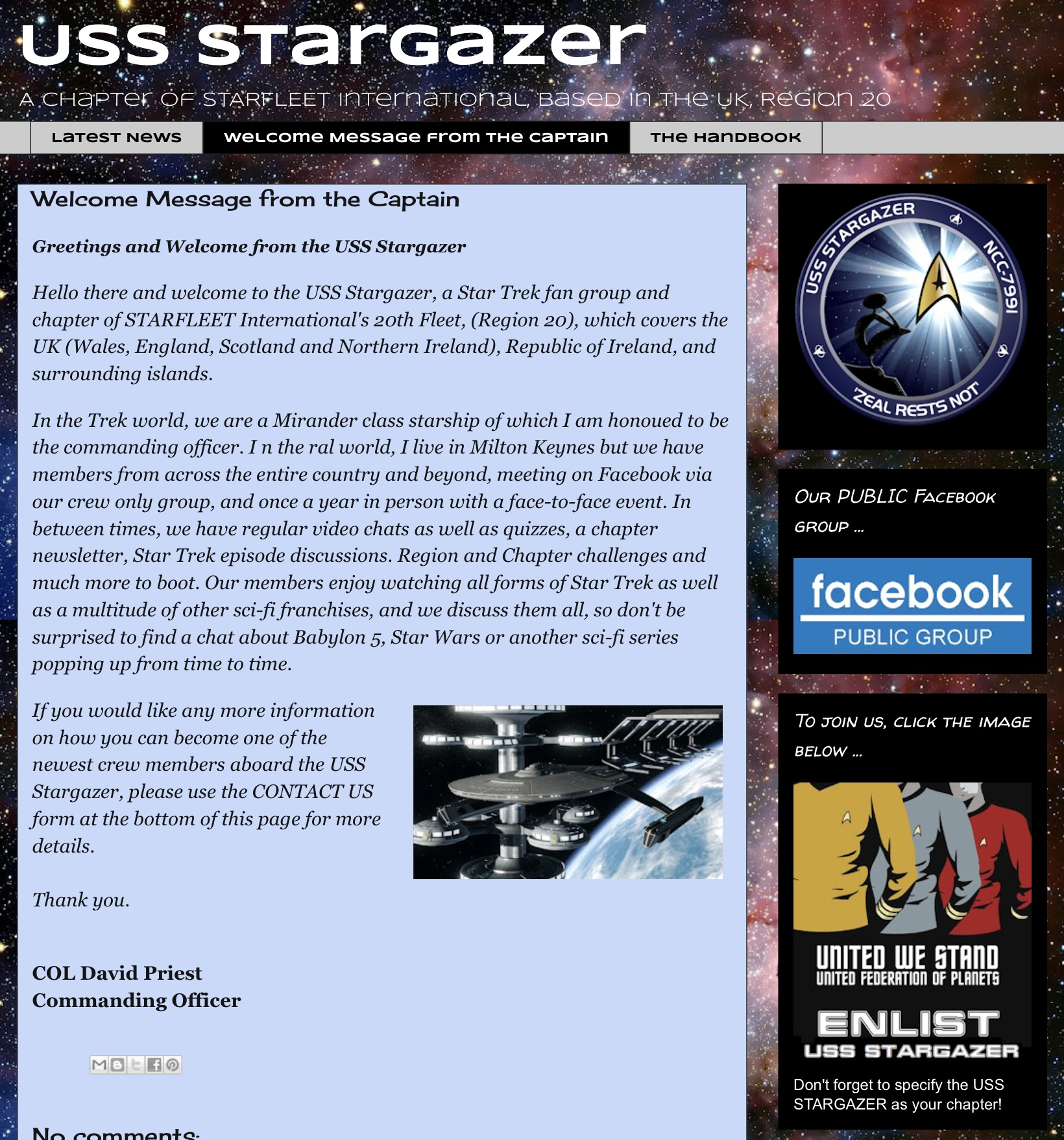
 If you would like any more information about how to become one of the newest crew members aboard the USS Stargazer, please use the CONTACT US form at the bottom of this page for more details.

